Showing posts with label dystopian. Show all posts

Wednesday, November 16, 2016

Interview with YA Author Heather Lotto


Today YA author Heather Letto shares about her book, The Imparting, a YA dytopian novel.

How did you choose the title The Imparting?
This is the last book of the Ascension Series… Book 1—Impervious, Book 2—Implanted, sooooo…. The IMP’s have it!  But more than that, in this story the imparting is the way to freedom… or death. 

Although the Ascension Series is a post-apocalyptic non-religious read, it is also Christian fiction because of its allegorical nature to the gospel message.


Did you design the cover?
I helped in the design (chose the model, and put in my two cents) BUT, Anita Carroll (@race-point.com), Cover designer extraordinaire is the artist.

How would you describe the book to someone in a text message?
Wow! They’re being held prisoner, and they don’t even know it!

Who is your main character and what problem does she face?
Fran. Well, Actually Sarah-Frances Monde, but she goes by Fran.  Her problems are many. At first, it might appear that her main problem is procuring dinner and dodging the Impervious holographic security. Yet, her brother’s MIA, and both of her parents already gone, so when her mentor slides down the awful slope of the decline, avoiding the Beast takes precedence. And then there’s Pete… and the Council…

What might draw someone to your character?
Anyone who has dealt with death, abandonment, living on the fringe of society, had a crush, wanted an adventure, feared for their life, or wondered what might be on the other side would probably relate to Fran. Those who haven’t experienced those sorts of things, might just be enamored by Fran’s no-B.S., kick-butt attitude. She’s pretty cool.


When you were young, what did you want to be when you grew up?
When I was young, (sigghhhhh) I wanted to be 1. An Olympic gymnast, 2. A flight attendant, 3. Janis Joplin. Yes… all at the same time.

Do you still want to be that?
Not really. I like who I am now. (Plus the above plan really sounds pretty exhausting!)

What’s the most times you’ve read a book and why?
I read Nicholas Spark’s A Walk to Remember three times! (And saw the movie twice!) Two of those three times I had forgotten I had read it already until a few chapters in. And then I was truly bummed, because I remembered what was going to happen. Then again, I did continue reading it.

What are three unusual things about you your readers might not know?
1.      While writing the final two books in the Ascension Series I was living in an R.V. travelling around the U.S.
2.      I cannot tolerate carpooling in a minivan or SUV. EVER.
3.      I’m a figure skater.

What’s the most adventurous thing you’ve ever done?
When I was a tween, I travelled from Argentina to the U.S. in a single engine six-passenger airplane that my father piloted.

I sense a story here …
Travel and adventure were big in my home growing up. As a matter of fact, when I was in the sixth grade, my parents moved the entire family from 'burbs of Chicago to Buenos Aires, Argentina, for a few years. For those unfamiliar with this country, Argentina sits on the Atlantic side of South America beneath the "belly" of Brazil. While living in the Southern Hemisphere, I lived a pretty normal life, going to school, hanging with friends, crushing on boys, etc. And during school breaks, we continued the tradition of family vacations. Yet, rather than Disney or the Grand Canyon, we had the beaches of Uruguay, the Andes Mountains of Chile and the Great Iguacu Falls bordering Argentina, Paraguay and Brazil. Good family fun, indeed. The biggest (and to date, the best) family trip we made, however, was when it was time to return 'home', and my father made the decision to pilot us back to the 'States' in his single engine, six-seater, Beachcraft  Bonanza airplane. This several-week journey took us through jungles to beaches and Amazonian villages to coastal mega-cities. Memories of walking on lily pads the size of car tires and dodging hairy tarantulas bigger than my fist compete with the visions of the exotic beaches of in Rio de Jainero and fancy buffets laden with tropical fruits, cheeses, yummy croissants, jellies and Dulce de Leche. I can still hear the hum of the outboard motor as we skipped along the Amazon river in a very 'rustic' boat with a local villager and the squeal of my mother as he dove in to 'swim with the piranhas.’ The faces of the Paraguayan women toting mammoth baskets of fruit on their heads makes me smile as much as the flock of  flamingos that graced our outdoor buffet. However, as tween, I can assure you, I also squabbled with my brother in the backseat of the plane when he took up more than his allotted space, or whined  "Can we land soon?"  (a lot). I mean, after all. I'm only human.

Favorite verse?
And we know that in all things God works for the good of those who love him, whoa have been called according to his purpose. Romans 8:28

What advice would you give a teen who wants to be a writer?
Work hard and be open to criticism. It’s how you grow.

~~~
November is BOOK PROMO MONTH for The Ascension Series! Impervious and Implanted have already had free download days, but they are both on sale for 0.99 for the rest of the month HERE 
 The Imparting will have a random FREE DOWNLOAD DAY within the next two weeks.
Watch for it on Facebook Fan page because it will be announced HERE 
AND
The Grand Prize Giveaway Drawing will be on November 30th  HERE
(Soft cover, signed copies of the entire trilogy, SWAG-GALORE*, AND A $25 Amazon gift card)

*Swag includes buttons, bracelets, bookmarks & chocolate

Order all three books from amazon HERE 

Tuesday, February 23, 2016

Book Review: City of Ember


I’ve read some young adult novels were written several years ago.  One of them was City of Ember, written in 2003. Previously, I’d only seen the movie, and before I read the book, I thought it was a good movie. Reading the book has made me realize how lacking the movie is. This book is for a younger age group than Hunger Games, Divergent or any of those. It’s kind of like a starter dystopian book for preteens.


Ember is an underground city that was designed to keep the remnants of humanity safe and isolated after the regular world was destroyed. It was only intended for the occupants to live in it for 200 years and then be released. Only the instructions aren’t passed down the way they are supposed to be, and the release doesn’t happen.
Lina and Doon discover damaged instructions written by the builders of Ember and begin a scavenger hunt of clues to break the code. Like many other dystopian books, children are assigned jobs at a certain age, in this case by drawing a slip of paper with a job written on it. Some jobs are good, others not so much. Lina and Doon both draw jobs they don’t want, but a simple trade of jobs benefits them both and put them in better positions to find out the key to reaching the surface.


From amazon.com:
It is always night in the city of Ember. But there is no moon, no stars. The only light during the regular twelve hours of "day" comes from floodlamps that cast a yellowish glow over the streets of the city. Beyond are the pitch-black Unknown Regions, which no one has ever explored because an understanding of fire and electricity has been lost, and with it the idea of a Moveable Light. "Besides," they tell each other, "there is nowhere but here" Among the many other things the people of Ember have forgotten is their past and a direction for their future. For 250 years they have lived pleasantly, because there has been plenty of everything in the vast storerooms. But now there are more and more empty shelves--and more and more times when the lights flicker and go out, leaving them in terrifying blackness for long minutes. What will happen when the generator finally fails?

Twelve-year-old Doon Harrow and Lina Mayfleet seem to be the only people who are worried. They have just been assigned their life jobs--Lina as a messenger, which leads her to knowledge of some unsettling secrets, and Doon as a Pipeworker, repairing the plumbing in the tunnels under the city where a river roars through the darkness. But when Lina finds a very old paper with enigmatic "Instructions for Egress," they use the advantages of their jobs to begin to puzzle out the frightening and dangerous way to the city of light of which Lina has dreamed. As they set out on their mission, the haunting setting and breathless action of this stunning first novel will have teens clamoring for a sequel. (There are now three more books in the series)


My random and rambling thoughts:
There are differences between the book and the movie. In fact, the only similarities are the assignment of jobs, the poor condition of Ember and the fact that they get out.
In the movie, the order of events are changed.  People’s roles and stories are changed and the way Lina and Doon escape.

In the book, there is a lot of plot that has to do with the mayor taking the resources, Lina and Doon reporting him to the guards and then being wanted for spreading vicious rumors. None of this happens in the movie.

In the movie, the instructions act more like a map while in the book a lot more time is spend following clues and trying to decipher the clues. The movie adds a glass plate used as a key to help get out is added.

The role of the fathers are totally different in the book and movie. In the book, neither Doon nor Lina’s fathers are involved in the escape from Ember, but in the movie, Lina’s father thought the way out was the river and drown trying to get out. Doon finds out his father was working with Lina’s, and Doon tells his father about the instructions.
The weirdest difference is the inclusion of a giant mole in the movie. It roams the pipes, and is responsible for the mayor’s demise.

As far as the escape from Ember, there are too many differences to even go into. 
Overall I think the movie is a very shallow portrayal of the book. It’s worth the time to read it to get more of the story, deeper insights into Ember, its citizens, the mayor and the main characters Lina and Doon.  The way they figure out the exit and leave the city are much more fulfilling.

This book is appropriate for preteens.  Teens may be somewhat bored, but they may also find it an easy, quick read.


Here is what Plugged In Online says:

YOU CAN READ THE WHOLE REVIEW HERE


Two hundred years.
That's how long the remnants of humanity have lived deep underground after an unspecified apocalypse rendered Earth's surface unlivable. For generations, the citizens of the city known as Ember have depended upon a massive generator (powered by an underground river) to keep their beloved subterranean suburb humming.
Now, inexplicably, the great generator is failing. Power outages—accompanied by terrible blackness—are getting longer. Stockpiles of food that have sustained Ember for two centuries seem to be running low.
But the majority of Ember's citizenry stubbornly refuses to believe that life as they've always known it might be coming to an end. Chief among the skeptics is Ember's portly mayor, who calmly establishes a task force to look into these interruptions in the status quo.
Doon Harrow, the son of an inventor, believes he can repair the generator, if only he can get access to it. But the really bright thread of this story emerges from the weave when Lina Mayfleet's preschool-age sister, Poppy, discovers a mysterious box in the closet of their home ... a box apparently left behind by an ancestor who was also the city's seventh mayor. Lina's granny (with whom she lives) faintly recalls that the box was important. But she can't remember why.
Doon's path crosses Lina's on Assignment Day—the day teens graduate from school to adult jobs in the city. And as Ember's power outages grow longer, Doon and Lina race against time to decipher confusing clues in an ever-deepening mystery. Hidden tunnels. Cryptic instructions. Monstrous creatures lurking in the shadows.
Piece by piece, the picture becomes clear: Ember wasn't designed to be a permanent home for humanity, only a temporary shelter. The people must return to the surface.
But someone, it seems, doesn't want them to get there.


POSITIVE ELEMENTS
City of Ember showcases the values of hard work, family and pursuing the truth even if others discourage you.
Personal career plans don't play well in a society built around sheer survival. And in Ember, adults are randomly assigned lifetime occupations. Despite that, most of Ember's citizenry admirably shoulder their responsibilities. Pipe fitters stop leaks. Electricians tend to the power grid. Greenhouse keepers ensure production of fresh food to complement stored canned goods. And so on.
Doon's father, Loris, encourages the virtues of hard work and perseverance. Loris tells Doon that he has little control over life circumstances ("What you get, you get"), but that his response to those circumstances is what really matters ("What you do with what you get is more the point").
Both Doon and Lina come from loving, if fractured, families. Lina lives with and cares for her elderly granny. (We learn that her parents were killed years before in an accident.) And Lina also tends to the needs of her younger sister. In essence, she's assuming adult responsibilities even before she graduates into the adult world of Ember, putting the needs of her family before her own. When Granny quietly passes away following a respiratory illness (we see her in her bed when she doesn't wake up), Lina and Poppy go to live with a kindhearted family friend named Mrs. Murdo.
As Doon and Lina inch closer to uncovering the secret of Ember's builders—and the escape plan they engineered—the teens repeatedly come to each other's rescue in moments of peril. Several other characters, including a greenhouse custodian and an aging pipeworks laborer, also place their lives on the line in the service of the quest for the truth.
[Spoiler Warning] Loris initially discourages Doon from trying to find an escape from the city. But we learn that Loris is doing so because a similar venture took the lives of several of his friends when he was much younger. Eventually Loris changes his mind, though, and encourages his son to continue pursuing the quest that he abandoned himself.
Lina discovers that an acquaintance her age has been stealing food in her role as a warehouse steward. Though the young thief tries to rationalize her behavior by saying there's so little food remaining that it doesn't matter, Lina tells her that what she's doing is still wrong.


CONCLUSION

City of Ember is a peculiar movie. As post-apocalyptic action flicks go, it has remarkably few content concerns. The two scenes with the mutated mole are the worst of it, along with some mild fisticuffs and moments of suspense. It's a rare film these days, even among those labeled as "family friendly," that has so few problems. So it would seem that Walden Media continues its commitment to bringing enjoyable, restrained stories to the big screen.
Digging a bit deeper, though, there may be a bit more going on here. On the surface, City of Ember is an engaging story about two teens whose determination to find the truth and challenge the status quo ends up saving humanity. And the consistent theme of moving from darkness to light could even be interpreted as having spiritually meaningful undertones.
On the other hand, the film arguably suggests that neither organized religion nor politics will provide the solutions that society desperately needs. For that matter, adults generally seem unwilling to consider new ways of looking at the world or solving problems. While it would be a stretch to call these messages subversive, neither the "spiritually faithful" nor public leaders tasked with shepherding the city garner much praise here. The former are hopelessly untethered from reality, while the latter are too crooked to be trusted. In the end, Doon and Lina can only trust themselves—a message that's both deeply humanist and pretty pessimistic at the same time.
Speaking of pessimism, consider for a moment City of Ember's setting: We never know exactly why humans were forced underground, whether the catalyst was global ecological disaster or perhaps a nuclear war. All we're told is that the scientists believed it would take 200 years before the earth would be habitable again. "On the day the world ended," a voiceover tells us, "The fate of mankind was carried in a small metal box."
Stories about the end of the world are nothing new, of course. But not so very long ago, they were aimed primarily at older audiences. In her article "Unhappily Ever After," Newsweek columnist Karen Springen writes, "Once upon a time, doomsday stories—War of the Worlds, Planet of the Apes—were adults-only fare. Today one of the hottest segments of children's literature is about surviving the end of the world."
And, indeed, City of Ember is based on a bestselling children's book of the same name.
"We have more ways of ending the world than we had before," says Jeanne DuPrau, who wrote the book. "These are big, hard truths that are facing kids, and they need to know these things."
Whether they need to know these things or not is still debatable, of course. But the fact that they do indeed stumble upon them is incontestable. And families are going to have to individually grapple with how a film like City of Ember fits into that not-always-slow-enough growing up process. If it does fit, it should certainly be used to spark conversation and learning, not just serve as mindless entertainment. But that path is opened up in this case—far more than it normally is when it comes to movies—by the aforementioned restraint shown by the film's makers


Tuesday, January 26, 2016

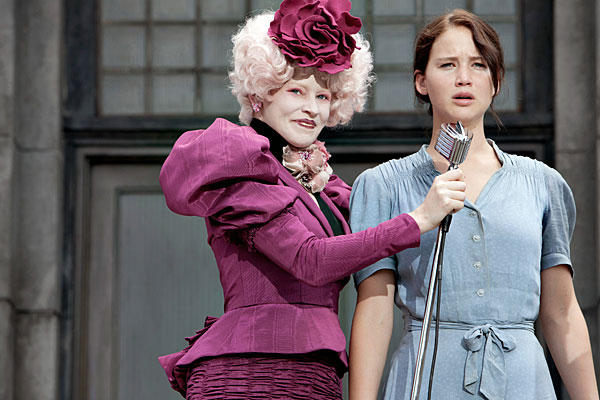
Movie Review: Hunger Games: The Movie

In the last post, Christian fantasy author, Bryan Davis shared his review of the book The Hunger Games. In this post, he shares his thoughts on the movie.


First, the movie was considerably better than the book, because it eliminated some of the writing flaws. The first is obvious. A film naturally describes every scene. The book rarely described anything, making the reader blind to almost everything. The film explored the details with excellent visuals. 

 Second, the film viewer doesn’t have to endure the clunky first person present tense writing that’s in the book. 

 Third, some story flaws are mended. Katniss comes off as less selfish in the movie, thereby making her a more believable heroine. The silly kissing and romance are minimized. The back story is greatly enhanced by showing what’s going on behind the scenes during the games. The nudity is eliminated. 
The film tried, relatively unsuccessfully, to bring Gale back into the story, a component the author ignored, but I appreciated the attempt. He got lost in the story. 

 The acting was quite good overall. The actress for Katniss was exceptional. The actor for Peeta was very good, excellent at times. 

 Random thoughts: 

  •  The actress for Katniss was too old and too well fed. 
  •  The shaky camera was annoying, especially at the beginning. 
  •  The death scene with Rue was well done, nice emotional pull. 
  •  The dog creatures at the end were still a poorly conceived device, even though the film made a valiant attempt at foreshadowing them. 
  •  The change of rules and then back was still there, the single biggest flaw in the story. It would have been very difficult to eliminate it, but it was still frustrating. I wanted to know if Katniss would sacrifice to help Peeta even if she knew he might kill her or she might have to kill him. Katniss never faced the dilemmas that the premise set up. It’s like a promise that isn’t kept, which made for a unsatisfying experience. 
  •  The entire premise that the powers that be would destroy a rebellious district is unbelievable. They would be cutting off essential supplies. So the idea that the districts would acquiesce to sending their loved ones to die doesn’t work. Again, the film would have been hard pressed to change that. 
  •  I like the grittiness and realism at the beginning, the poor clothing, dirty conditions, and no makeup. 


Overall, I rate it 3.5 stars out of 5. If not for the last two flaws I mentioned, it could have been a 4.5-star movie, but these decisions were the author's fault, not the film maker's, so I gave it an overall positive score as a movie.

Do you agree or disagree with Bryan's review? Did you prefer the book or the movie? Why?

You can read more about Bryan Davis HERE

Saturday, January 23, 2016

Book Review: The Hunger Games

The following review of The Hunger Games was written by author Bryan Davis. After you read the interview, leave a comment in the comment section--do you agree with all, some or none of his review of the book? Why?

Bryan has written several best selling young adult fantasy books. You can read his interview HERE. This review is being used with his permission. He also has a review of the movie, which I will be posting soon. 


 The Hunger Games is a dystopian/science fiction novel targeted for young adult readers. Since the genre is the same as my daughter’s novel, and since it is so popular and highly acclaimed, I decided to read it while flying home from Singapore.

First, I will list some of the good qualities. The Hunger Games accomplished two important feats – it held my interest throughout and kept me thinking about the story and characters after I closed the book. This doesn’t often happen to me, so I consider this to be a strong quality. If a story can’t hold my interest, I simply don’t finish. I don’t have time to read a boring book.

The author developed the main character (Katniss) quite well. Her traits (with one exception) were clear and consistent. For the most part, she was likeable and easy to follow. I will get to the exception soon.

The level of action, for the most part, proceeded at a good pace with appropriate pauses for rest and reflection. The author used foreshadowing quite well, better than most.

Now I will list some negatives. The first I noticed was the use of present tense. I found it annoying and unnecessary. It constantly jerked me out of the story, and I never got used to it.

The author’s use of fragments in narrative was also annoying. I understand the need for fragments in dialog and interior monolog, but it is simply wrong in narrative. It is a gimmick that has become popular of late, and it doesn’t work. There were many times that a comma would have made a proper sentence, and the use of a period instead had no reasonable explanation. Every use jerked me out of the story, and such jarring is so easily avoidable.

For example (page 6 in my copy):

"In the autumn, a few brave souls sneak into the woods to harvest apples. But always in sight of the Meadow. Always close enough to run back to the safety of District 12 if trouble arises."

The second two "sentences" are not sentences at all. If the author had put commas after "apples" and "Meadow" instead of periods, the entire section would have been grammatically correct. There is no reason to use periods except for employing a gimmick that doesn't work.

This example also points out how the use of present tense has problems. "In the autumn" indicates a time that differs from the present, but the section is still written in the present tense, which doesn't make sense at all.

On another point, the author was inexplicably inconsistent with speaker tag placements—sometimes near the beginning of a dialog segment, sometimes in the middle, sometimes at the end. It was especially distracting when she placed a speaker tag at the end of a several-sentence paragraph, and I found that the speaker wasn’t who I thought it was. When the speaker isn’t obvious, it is always better to put the tag as near to the beginning of the spoken portion as possible. The other option is to identify the speaker with an action beat at the beginning. If the speaker is obvious, there is no need for a tag at all.

The author did a poor job with scene-setting descriptions. I am a minimalist with descriptions in my own work, but I strive to provide enough to set the scene. Ms. Collins describes almost nothing. I could rarely see the places at all, and there were plenty of places to set the scenes unobtrusively. The arena was barely visible. What did the hovercraft look like? The training facility? I didn’t realize the size of the cornucopia until they climbed onto it at the end. Practically nothing was described sufficiently.

***Caution, spoilers ahead

The author did a poor job with world building. The motivations for the games themselves were lacking. Sure, I understood the punishment and warning angle, but she didn’t provide any counterbalance to explain if the citizens debated refusal to cooperate. If they did, what was their reason for not rebelling? Annihilation was threatened, but it was an empty threat. They leaders couldn’t afford to annihilate everyone. Some of these issues lacked sufficient exploration. Also, many of the technology aspects had little to no explanation. Where did the silver parachutes originate? How could they be delivered without notice? How could they fall so precisely, like in the crook of the tree where Katniss slept? How could there be cameras wherever they went, no matter where they went, all without notice? Explaining some of these issues is a huge part of world building. These were a big part of the story, so I got the impression that the author had no idea how to explain them, or just didn’t want to bother. Also, if the technology was that advanced, why did they need a train to get to the training facility? Much of this felt like the author was simply pulling a rabbit out of a hat.

The romantic angle seemed very contrived. Although Katniss was a well-developed character for the most part, when it came to her relationship with Peeta, she became a shallow drone. With most of the story, she was smart and strong, but she was clueless when it came to understanding what Peeta was doing. I suppose that every reader in the world knew what Peeta was doing, but Katniss was too stupid to figure it out, which created a situation that ruined suspension of disbelief. Katniss was too smart most of the time to be that stupid regarding Peeta. I get the impression that the author just tossed the romance into the mix in order to titillate readers, especially the ridiculous kissing parts, but it doesn’t work at all. In fact, this is the biggest flaw in the story and makes me unable to recommend it to anyone. The romance was completely unnecessary to the point of being silly.

Another story flaw is the author’s decision to create a midstream rules change that allows for two winners from the same district. This really took the edge off the intensity, and it was a big letdown. Would Katniss have helped Peeta so willingly and so painstakingly if she still thought he might kill her? That would have been a fantastic idea to explore, but the rules change removed that tension. The threatened suicide that comes later would have been more powerful without the change and then the change back. The leaders would have still wanted a victor, and if Katniss and Peeta had selflessly refused to kill one another, their final decision would have had much greater impact.

The story is lacking any deep thematic element. It explores brutality and despotic rule, and there is some examination of selfishness versus sacrifice, but the author doesn’t seem to have enough of a moral compass to allow for a look at real selflessness. If she had avoided the rule change, she would have had a prime opportunity. The most redeeming element was how Katniss treated Rue, both in life and in death. Their teamwork was fun to read. Still, since Rue died, we don’t get to see how Katniss would have decided to treat her if it came time to have to kill her. The avoidance of this issue with Rue and with Peeta really hurt the thematic depth.

***End of spoilers

I mentioned some strong positives at the beginning of this review, but they are not enough to outweigh the big negatives. If the author could have removed just a few of the negatives, I probably could have recommended this book. As it stands, I don’t want to read the sequel. I think I will find some of the same big flaws, and they would probably be too annoying or disappointing to get through.

This could have been a great book. Unfortunately, it is mediocre to poor. I give it 2.5 stars out of 5.


Bryan's website is HERE

Saturday, January 2, 2016

Interview with Monica Mynk

Today we are "talking" with Monica Mynk, author of the Young Adult dystopian novel Cavernous. 

Monica is a high school science teacher and soccer mom as well as being an author. She considers herself a 100% total nerd.
Her early years were spent reading books with her mother, acting out plays with her brother and sister, climbing in corncribs, and helping her dad on the farm.


 About Cavernous:
How did you choose the title?
It came about from the idea of being "filled" with Scripture, and that one who is devoid of scripture is completely empty. I also wanted to show a girl broken down to the deepest part of her soul, and have her undergo a metamorphosis to become a true soldier for Christ. The second book is Cocooned, where she learns how to take that stand, and the third is Conceded, which is where she fully submits herself to God's will.


How would you describe the book to someone in a text message? 
In a divided America, an extremist leader rewrites the Bible to suit his whim. He has one weakness--his daughter, who's written the word of God on her heart.

Who is your main character and what problem does he/she face? 
Callie Noland. Her mom goes missing, and she's abducted by a man claiming to be her father. He forces her to attend a military school in the newly-formed Alliance of American States. While there, she learns he's been elected to lead the new country, and she must stand by his side as First Daughter, which means she must publicly participate in blasphemous ceremonies or face imminent death. She knows the Bible, though, and feels compelled to stand up for the truth. Can she overcome her fear of death to make that stand?

What might draw someone to your character? 
She's tenacious, determined, and steadfast. 

What prompted you to write this book?
 I worry that too many people get their Biblical knowledge from memes and social media today. If an extremist leader rewrote the Bible and presented it as truth, how many of us would know the difference?

What did you bring to the book from your own life? 
I teach teenagers, so Callie is a blend of some of the better qualities of my favorite students. I wanted a strong, realistic character, and I hope she comes across that way.

What makes your book stand out from other books like it? 
It was written to incite readers to dive into Scripture. My hope is that it will inspire young people and adults alike to read and memorize verses the way Callie did in the book. I tried hard to not make this preachy, but rather show it as a necessity to preserve what God’s given us.

What is one thing you learned from writing this book? 
I needed to study editing techniques, ha ha. It was the first novel I wrote after actually learning the craft of writing, so I had to go back and rewrite a good part of it because of sagging middle, etc. 

About You:
When you were young, what did you want to be when you grew up? 
I wanted to be on Sesame Street

Do you still want to be that? 
J Not so much. But I'd like to visit the set sometime.

When did you know you wanted to be an author?
I always liked writing, but started pursuing it in earnest when my best friend died of cancer a few years ago. I desperately needed a hobby and something to fill the time we'd spent texting back and forth and such. I never dreamed of pursuing it as a career until critique partners encouraged me to start submitting to contests and I placed in a few. I've been blessed with incredible encouragement.

What books have influenced you most? 
Pretty much all of the Francine Rivers books, the Chronicles of Narnia, David Baldacci's Wish You Well, Khaled Hosseini's A Thousand Splendid Suns, and so many others. 

What’s the most times you’ve read a book and why? Title?
 I've read all the Harry Potter books several times. Not so much because I liked the all the stories, but because I wanted to learn to write like J.K Rowling. Usually I don't reread books, because I always have five or six on my "to-read" list. 

What are three unusual things about you your readers might not know?
 I have a nuclear degree and I teach high school science. So I'm a 100% total nerd. 

What’s the most adventurous thing you’ve ever done? 
Have children? LOL Seriously, when I was about 21, I drove to Chicago by myself and stayed the weekend. Hit every museum on Lakeshore Drive. It was amazing! 

Do you have life philosophy?
My life philosophy changes with circumstance, but overall centers on having a positive contribution to the world. Right now, it's about becoming less in as many ways as I can. Like the song, less of self and more of Him.

What advice would you give a teen who wants to be a writer? 
Write a little every day, and at some point when you can afford it, hire a real editor to look over a chapter or two. A poorly written story can be molded into beauty with enough revision. A story never written has no chance.

 
Monica making cookies with her daughter.

You can find out more about Monica and her books HERE
Please leave her a comment below.